Findings: AI Code Survival¶
What happens to AI-written code after it merges? We ran git-aftermerge across open-source repositories that carry AI attribution in their commit history, plus one anonymized private repo, and compared — within each repo — how long AI-agent lines survive versus human lines.
10 repositories analyzed · 21,905 commits scanned · 3,346 AI-attributed (claude-code, openhands, gemini, cursor, aider, crush, copilot, amp, devin) · data collected August 2026.
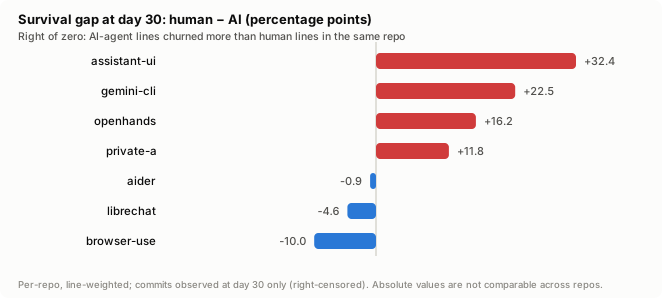
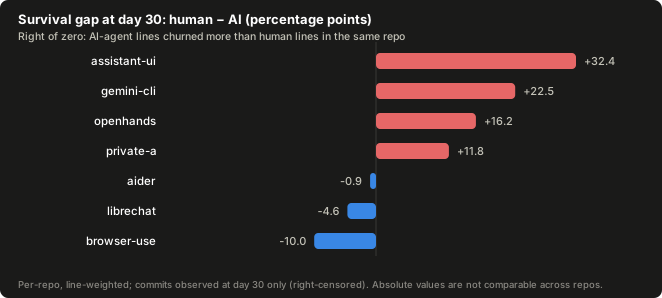
In the seven repos that pass the plausibility screen, the 30-day survival gap (human − AI, percentage points) runs from +32.4 down to −10.0: four repos show AI-agent lines churning meaningfully faster than human lines, aider sits at parity, and two (LibreChat, browser-use) tilt slightly the other way. And the gap has a shape: it lives almost entirely in brand-new code — see the maturity signal.
Survival curves, per repo¶
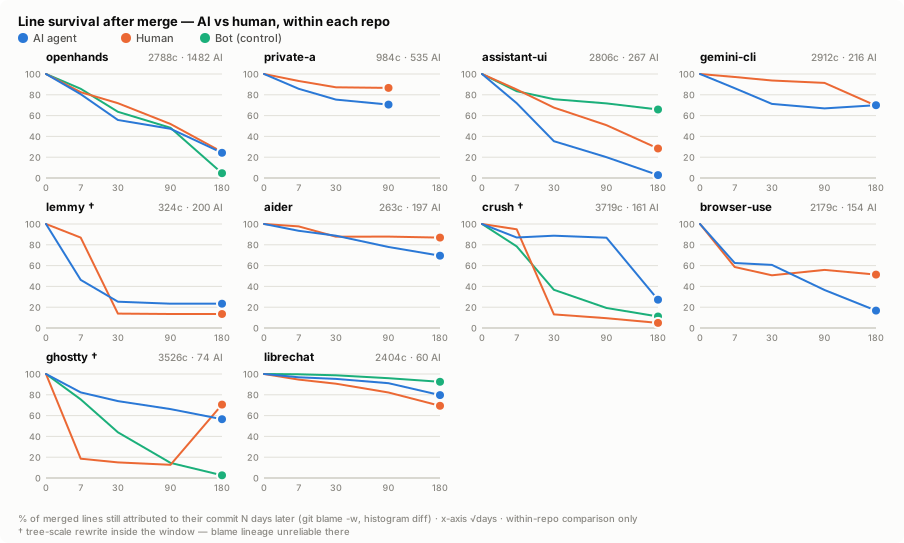
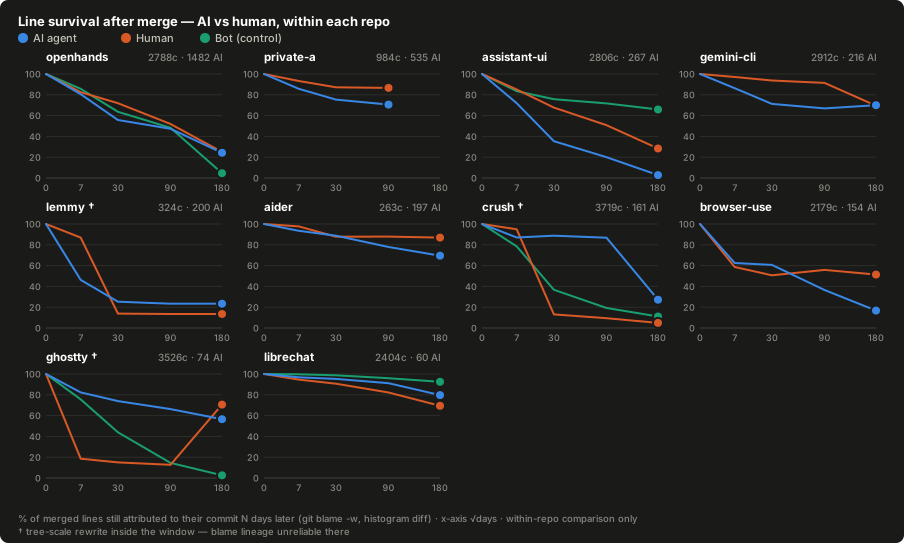
Each panel is one repository. Lines show the fraction of merged lines still
attributed to their commit N days later (git blame -w, histogram diff,
checkpoints at 7/30/90/180 days, right-censored).
The gap, repo by repo¶
The headline number per repo: human 30-day survival minus AI 30-day survival, in percentage points. Positive means AI-agent lines churned faster than human lines in that same repo.
Per-repo numbers¶
| Repo | Commits | AI commits | Tools | 30d AI | 30d human | 30d bot | Gap (pp) |
|---|---|---|---|---|---|---|---|
| openhands | 2788 | 1482 | openhands, claude-code | 55.8% (n=1195) | 72.0% (n=960) | 63.6% (n=79) | +16.2 |
| private-a | 984 | 535 | claude-code, cursor | 75.4% (n=530) | 87.2% (n=444) | — | +11.8 |
| assistant-ui | 2806 | 267 | claude-code, github-copilot | 35.3% (n=140) | 67.7% (n=1693) | 75.7% (n=159) | +32.4 |
| gemini-cli | 2912 | 216 | gemini | 71.2% (n=204) | 93.8% (n=2574) | — | +22.5 |
| lemmy | 324 | 200 | claude-code | 25.3% (n=198) | 13.9% (n=117) | — | † |
| aider | 263 | 197 | aider, claude-code | 88.7% (n=185) | 87.8% (n=60) | — | -0.9 |
| crush | 3719 | 161 | crush, claude-code | 88.8% (n=115) | 13.0% (n=2943) | 36.7% (n=95) | † |
| browser-use | 2179 | 154 | claude-code, cursor | 60.6% (n=146) | 50.6% (n=1793) | — | -10.0 |
| ghostty | 3526 | 74 | claude-code, amp | 74.0% (n=62) | 15.0% (n=2722) | 44.0% (n=115) | † |
| librechat | 2404 | 60 | claude-code, github-copilot | 95.3% (n=43) | 90.6% (n=1905) | 98.7% (n=112) | -4.6 |
† tree-scale rewrite inside the analysis window (a >50pp swing between adjacent checkpoints) — blame lineage unreliable, excluded from the gap chart.
How to read this¶
- Where AI is a minority contributor, its code churns faster. Four of the seven screened repos show a positive gap (+12 to +32 pp at day 30). The repos at or near parity (aider, LibreChat) are projects with long-established, review-heavy AI workflows.
- The inversions are informative, not noise. The repos where AI code outlives human code are AI-native projects where most development happens through an agent; there, "human" commits are often small manual fixes that the next agent pass rewrites.
- The negative control holds. Dependabot/Renovate commits (the
botcohort) are fully automated but deterministic. Where present in volume, bot lines survive better than both AI and human lines — automated-but-correct changes stick. If the detection logic were simply penalizing automation, the bot curve would look like the AI curve. It doesn't.
The maturity signal¶
Every file change records how old the touched code was, bucketed into tiers: new (< 30 days), young (30–365 days), mature (> 1 year). Slicing the 30-day gap by tier shows where the AI-vs-human difference actually lives:
| Repo | Gap, all commits | Gap, young-code commits only |
|---|---|---|
| assistant-ui | +32.4 | +2.3 (n=12 AI, 196 human) |
| openhands | +16.2 | −2.8 (n=164, 149) |
| gemini-cli | +22.5 | +15.6 (n=18, 235) |
| browser-use | −10.0 | −2.4 (n=9, 105) |
| librechat | −4.6 | −3.0 (n=6, 317) |
| aider | −0.9 | +1.4 (n=30, 9) |
In five of six repos with a young-code slice, the gap collapses to within ±3 pp once the commit touches code at least 30 days old — even in assistant-ui, whose overall gap is +32. gemini-cli is the exception that keeps a gap. Preliminary (the AI × young cells are small), but the shape is consistent: AI churn concentrates in freshly-written code being reworked again and again; when an agent edits established code, its changes stick about as well as a human's. This is exactly why churn numbers without a maturity layer are noise — healthy iteration on new features and AI breaking mature logic would otherwise count as the same thing. The mature (> 1 year) tier is still too thin to read; that needs older repos.
Methodology¶
- Within-repo comparison only. Repos that accept AI-attributed commits skew young, small, and single-maintainer. Comparing their churn to other projects measures selection, not AI. Every number here compares cohorts inside one repo, holding project maturity, team, domain, and test culture constant. Across repos we only look at the distribution of the difference.
- Attribution is trailer-based and conservative. A commit counts as
ai-agentonly if it carries a machine-readable trace:Co-Authored-By: Claude(Claude Code's default), Cursor/Copilot/aider/Devin/OpenHands/Gemini identities, or theGenerated-By:convention. AI use without trailers is invisible to us — cohort sizes are a lower bound, and repos where maintainers strip trailers show tiny AI cohorts regardless of actual AI use. - Survival = blame attribution. A line "survives" while
git blame -w(whitespace-insensitive, histogram diff) still attributes it to its commit. Checkpoints at 7/30/90/180/365 days after the committer date (when the change landed), observed only at repo states that contain the commit (merge-base --is-ancestor), so unmerged branch time counts as censoring, never as death. - Right-censoring, not extrapolation. A commit contributes to a checkpoint
only once it has aged past it. Each point shows its eligible cohort size
(
n=); points with n < 5 are dropped. - Plausibility screen. A swing larger than 50 pp between adjacent checkpoints of a well-sampled cohort (n ≥ 30) means a tree-scale rewrite (mass reformat, restructure, rebrand) happened inside the window — blame lineage is unreliable there. Such repos (†) stay in the curve grid but are excluded from the single-number gap chart. This screen exists because our ground-truth validation kept finding that implausible curves trace back to history events, not to code quality.
Caveats¶
- Cohort composition differs between checkpoints of the same curve (this is a per-checkpoint estimator, not Kaplan–Meier), so curves can wiggle where eligible sets change quickly.
- File renames break line lineage — renamed code reads as died.
- Nearly all analyzed changes touch new code (< 30 days old); the young-tier slices above are small, and the mature (> 1 year) tier is too thin to read until older repos join the sample.
- A revert of an AI commit authored by a human counts against the AI cohort, and vice versa — this is the intended semantics, but keep it in mind.
Reproduce¶
git clone https://github.com/inthepond/git-aftermerge && cd git-aftermerge
pip install -e .

# any repo, no init needed — how much attributed history is there?
git-aftermerge attribution --repo /path/to/repo

# the batch study
python scripts/batch_survival.py config.json workdir results.json --jobs 4
python scripts/make_charts.py results.json docs/assets/research
The exact per-repo results behind these charts: batch-results.json.
Private repos appear as private-* with paths stripped.